Notebook 00a — Why post-quantum cryptography?#
Today’s encryption would unravel the day a sufficiently large quantum computer exists. This book is about one of the replacements — ML-KEM — and what it takes to build it from scratch.
The quantum threat in one slide#
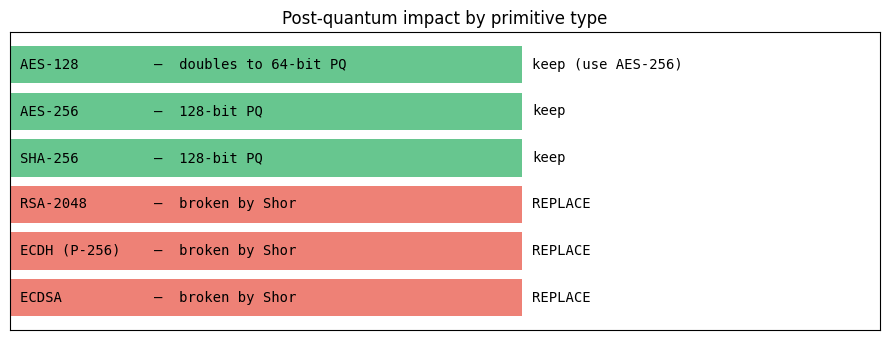
Shor’s algorithm (1994): on a sufficiently large quantum computer, solves integer factorization and discrete logarithm in polynomial time. That is exactly what RSA, Diffie-Hellman, and elliptic-curve crypto rely on. So Shor, if run at scale, breaks nearly all current public-key crypto.
Grover’s algorithm: quadratic speedup for unstructured search. This weakens symmetric crypto (AES-128 → ~64-bit quantum security) but doesn’t break it — doubling key size is enough (AES-256 stays strong).
The upshot: symmetric and hash primitives are mostly fine (with bigger keys); asymmetric crypto must be replaced entirely.
import matplotlib.pyplot as plt
primitives = [
    ("AES-128",      "symmetric",  "doubles to 64-bit PQ", "keep (use AES-256)"),
    ("AES-256",      "symmetric",  "128-bit PQ",           "keep"),
    ("SHA-256",      "hash",       "128-bit PQ",           "keep"),
    ("RSA-2048",     "asymmetric", "broken by Shor",       "REPLACE"),
    ("ECDH (P-256)", "asymmetric", "broken by Shor",       "REPLACE"),
    ("ECDSA",        "asymmetric", "broken by Shor",       "REPLACE"),
]
fig, ax = plt.subplots(figsize=(9, 3.5))
for i, (name, kind, q_impact, action) in enumerate(primitives):
    color = "#e74c3c" if "REPLACE" in action else "#27ae60"
    ax.barh(i, 1, color=color, alpha=0.7)
    ax.text(0.02, i, f"{name:14}  —  {q_impact}", va="center", fontsize=10, family="monospace")
    ax.text(1.02, i, action, va="center", fontsize=10, family="monospace")
ax.set_yticks([]); ax.set_xticks([]); ax.set_xlim(0, 1.7)
ax.set_title("Post-quantum impact by primitive type", fontsize=12)
ax.invert_yaxis()
plt.tight_layout(); plt.show()
“Harvest now, decrypt later”#
An adversary can record encrypted traffic today (even if they can’t read it) and decrypt it years later when quantum computers mature. Data with long confidentiality horizons — government secrets, medical records, personal chats, IP — is already at risk. This is why PQC migration can’t wait for Q-Day.
Where we are (2024–2026)#
2016: NIST opens the PQC standardization competition.
2022: four finalists selected (Kyber as the primary KEM; Dilithium, Falcon, SPHINCS+ for signatures).
2024 August: NIST publishes FIPS 203 (ML-KEM), FIPS 204 (ML-DSA), FIPS 205 (SLH-DSA).
2024 onward: deployed in production by Apple iMessage (PQ3), Signal (PQXDH), Chrome (X25519Kyber768), Cloudflare, AWS KMS.
Q-Day: no one knows. Estimates range from “10 years” to “never at scale.” The migration is happening regardless, because of harvest-now-decrypt-later.
What this book covers#
We implement ML-KEM — the key encapsulation mechanism chosen by NIST as the main post-quantum replacement for Diffie-Hellman-style key exchange. It is one piece of the puzzle: digital signatures (ML-DSA, SLH-DSA) are covered briefly in Part 3.
Before you proceed#
If you already know what RSA does, what a KEM is, and are comfortable with modular arithmetic, skip Part 1 and go straight to 01_lattice_intro. Otherwise, continue with 00b_classical_crypto_recap.