Notebook 03 — Break it yourself#
We implement two attacks on toy LWE and watch how they scale. The lesson: noise is what makes LWE hard, and brute force blows up exponentially in the dimension.
import numpy as np, time
import matplotlib.pyplot as plt
from pqc_edu.lwe import toy_keygen
from pqc_edu.attacks import brute_force_secret, gaussian_elimination_noiseless, verify_secret
Experiment 1 — noise-less LWE is just linear algebra#
If \(\sigma = 0\), the samples satisfy \(b = A s \bmod q\) exactly. That is a consistent linear system over \(\mathbb{Z}_q\), which Gaussian elimination solves directly in \(O(n^3)\) time. Without noise, there is no LWE — it’s just linear algebra.
rng = np.random.default_rng(0)
pk, sk = toy_keygen(n=20, q=257, sigma=0.0, rng=rng, m=40)
res = gaussian_elimination_noiseless(pk)
print(f'method: {res.method}, seconds: {res.seconds:.4f}')
print('recovered =', res.secret)
print('expected  =', sk.s)
print('match:', verify_secret(sk, res.secret))
method: gaussian_elimination_noiseless, seconds: 0.0018
recovered = [218 163 131  69  79  10  19   4  45 209 166 234 129 155 249 187 162 139
 143 240]
expected  = [218 163 131  69  79  10  19   4  45 209 166 234 129 155 249 187 162 139
 143 240]
match: True
Experiment 2 — add noise and linear algebra breaks#
Even tiny Gaussian noise \(e_i\) means \(A s \ne b\) exactly. Gaussian elimination then solves the wrong system and returns a garbage secret. Noise is what turns a trivial linear-algebra problem into a hard lattice problem.
rng = np.random.default_rng(0)
pk, sk = toy_keygen(n=20, q=257, sigma=1.5, rng=rng, m=40)
res = gaussian_elimination_noiseless(pk)
print('match:', verify_secret(sk, res.secret))
print('noise breaks linear solve — we get a nonsense secret')
match: False
noise breaks linear solve — we get a nonsense secret
Experiment 3 — brute force#
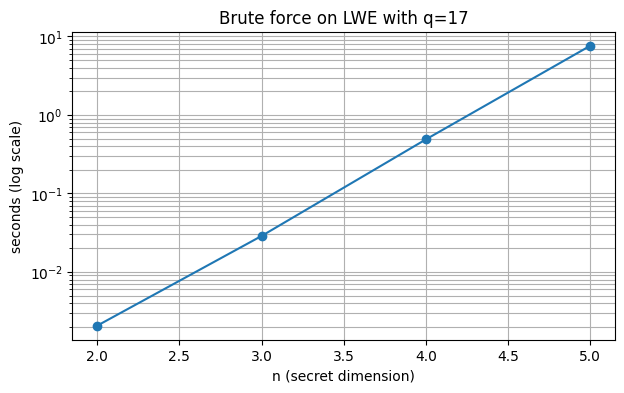
For tiny \(n\) we can simply enumerate all \(q^n\) candidate secrets and check each one against the samples. This always works in principle, but the work grows exponentially in \(n\). Let’s measure the growth.
ns = [2, 3, 4, 5]
q = 17  # small q to keep the search space tiny
times = []
for n in ns:
    rng = np.random.default_rng(n)
    pk, sk = toy_keygen(n=n, q=q, sigma=0.5, rng=rng, m=4 * n)
    res = brute_force_secret(pk, error_tolerance=1, time_budget_s=30)
    ok = verify_secret(sk, res.secret)
    print(f'n={n}: {res.seconds:.3f}s, recovered={ok}')
    times.append(res.seconds)

plt.figure(figsize=(7, 4))
plt.semilogy(ns, times, 'o-')
plt.xlabel('n (secret dimension)')
plt.ylabel('seconds (log scale)')
plt.title(f'Brute force on LWE with q={q}')
plt.grid(True, which='both')
plt.show()
n=2: 0.002s, recovered=True
n=3: 0.029s, recovered=True
n=4: 0.488s, recovered=True
n=5: 7.622s, recovered=True
Extrapolation#
Each \(+1\) to \(n\) multiplies the search space by \(q\). If \(n=5\) took \(T\) seconds, then \(n=16\) would take \(T \cdot q^{11} = T \cdot 17^{11}\) seconds. At \(q=17\) that’s roughly 35 billion times slower.
For ML-KEM’s real parameters (effective \(n=256\), modulus \(q=3329\)), the numbers are astronomical — well beyond the age of the universe on any classical or quantum hardware.
T_last = times[-1]
n_last = ns[-1]
n_target = 16
factor = q ** (n_target - n_last)
years = T_last * factor / (365.25 * 24 * 3600)
print(f'n={n_target} extrapolated: {years:.2e} years')
n=16 extrapolated: 8.28e+06 years
State-of-the-art attacks#
Real cryptanalysis is exponentially faster than brute force — but still exponential in dimension for well-chosen parameters. Key techniques:
BKZ lattice reduction — find short vectors in a lattice built from the samples.
Primal / dual embeddings — reformulate LWE as a uSVP or BDD problem.
Dual attacks with hints — modern variants that exploit structure.
For ML-KEM-512, the best known attack costs roughly \(2^{143}\) operations. The standard tool for assessing concrete hardness is the LWE estimator (Albrecht et al.), which tracks all known attacks and picks the best one for a given parameter set.
→ Next: 04_polynomial_rings.ipynb — the trick that makes ML-KEM fast.